
Head to Tamil Nadu, just as captivating! Home to the ancient great dynasties of South India, less well-known than those of North India, but just as powerful, this region is full of treasures to discover. Hindu deities are worshipped with great splendor: adorned with thousands of statues painted in colors as ardent as the country’s religious devotion, the Dravidian temples are more gigantic and countless than elsewhere.
This region is a perfect blend of turbulent modernity and the unwavering practice of ancestral traditions. From the majestic ancient temples of Mahabalipuram, Thanjavur, and Madurai to the colorful, flower-lined streets of Pondicherry and the delicious local cuisine, immerse yourself in the rich culture and warm hospitality of Tamil Nadu and let yourself be transported by this unique atmosphere.
You never tire of the subcontinent because each region thrills you in an incomparable way. Punctuated with experiences and excursions off the beaten track, your tour of South India takes you on an exclusive panorama of the must-sees of Tamil Nadu.
Day 1
Chennai International Airport – Mahabalipuram
Walk to the Descent of the Ganges
As soon as you step off the plane in Chennai, the capital of the state of Tamil Nadu, your driver will greet you. You’ll head with him to your hotel in Mahabalipuram. In the afternoon, you’ll stroll through the joyful sea air to the Shore Temple. Unlike the rock-carved sanctuaries, this is one of the first temples built by humans. Inside, the god Vishnu lies reclining. Nearby, you’ll be transported by the Descent of the Ganges, considered the largest bas-relief in the world, depicting the course of the sacred river pouring from the sky onto the Himalayas. Your stay in South India is off to a good start!
Day 2: Mahabalipuram – Tiruvannamalai
Early morning to discover the famous temple complex located on the edge of the Bay of Bengal, which gradually reveals itself at sunrise. Like immense sandcastles rising on the magnificent beach of Mahäbalipuram, vestiges of the Pallava dynasty listed by UNESCO: the Shore Temple, which has braved the sea for more than 800 years, is a temple built between 700 and 728 by the Pallava king Rajasimha Narasimhavarman II on the coast of the Bay of Bengal. It is one of the first temples built, as opposed to temples dug into caves or excavated in cliffs. The relief of the Descent of the Ganges, is a bas-relief dating from the 7th century, probably the largest in the world. The sculptures that cover the entire surface of two enormous rocks, 27 meters long and 9 meters high, depict the course of the Ganges from the Heavens and the Himalayas. The Five Ratha, Yudhishthira (or Dharmaraja), Bhima, Arjuna, Draupadi and Nakula-Sahadeva dedicated to the epic heroes of the Mahabharata are monolithic monuments of different sizes and shapes excavated from a small hill, gently sloping south, south of the village, not forgetting the Varaha cave, a rock-cut cave temple.
Head to Tiruvannamalai, the city of peace and harmony, and an important center dedicated to Shiva. Tiruvannamalai is a small marvel dating back to the 11th century, boasting over 100 temples, including the Arunachaleswara temple, which is considered the largest and one of the most fascinating in India. The main Gopuram is 66 meters high. The temple also houses one of the lingams of the 5 elements, that of fire. According to legend, Shiva appeared at the top of the hill in the form of a pillar of fire, thus creating the symbol of the lingam.
Day 3: Tiruvannamalai / Gingee / Pondicherry the white city
Heading to Pondicherry, a stop on the way at the impressive Gingee Fortress, founded in the 11th century, where the flag of the King of France flew in the 18th century. Are you fit to climb the Fort? The citadel connects three rocky hills, forming a triangle. At the summit, the King’s Fort and the Queen’s Fort rise 260 meters above the valley, offering views of the natural lakes that will make you want to linger.
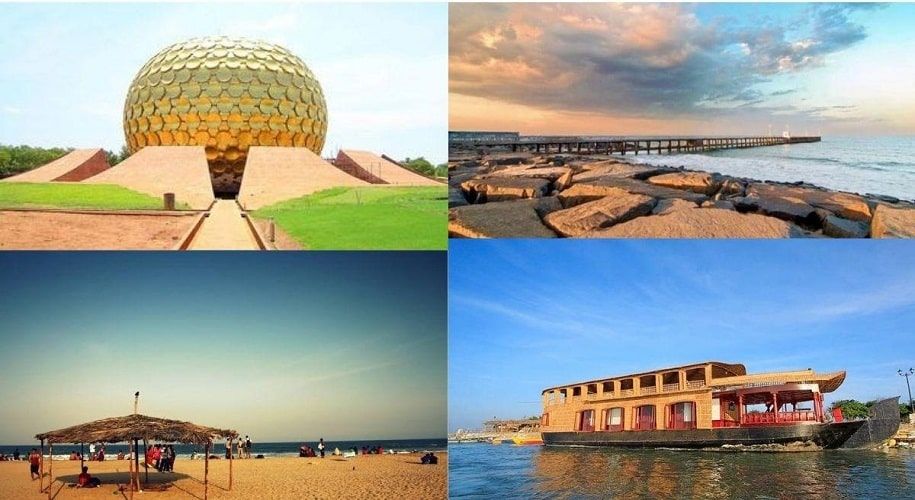
Pondicherry, a former French colonial trading post with a unique atmosphere and charm. Pondicherry, a former French colony established in India until 1954, is a city in the southeastern state of Tamil Nadu. Its French heritage is preserved in its namesake neighborhood, with its tree-lined streets, mustard-colored colonial villas, and chic boutiques. A seaside promenade runs along the Bay of Bengal and passes several statues, including the four-meter-high Gandhi Memorial.
Today, you’ll stay put to explore this city steeped in history. You’ll step back in time as you stroll, admiring the colonial architecture along the streets bearing French names. You can then continue to the Indian Quarter and discover its giant market, full of color and fragrance. You won’t be able to resist the charm of this diverse city.
Pondicherry, a small coastal village with a mild climate, “Pondy” became the French stronghold in India at the end of the 17th century. A presence that ended in 1954, but which transformed the city in depth and in appearance, with Tamil and French architecture blending into a unique Creole style. The Ganesh temple stands alongside churches built by missionaries, Tamil markets alongside pétanque courts. You stroll through sleepy squares where oleanders grow; you pass by villas with wooden shutters, twin sisters of the houses of Aix-en-Provence; you are surprised by the familiar-sounding street names, “rue Saint-Louis”, “rue de la Marine”. One cannot miss the opportunity to explore the Tamil city, its streets lined with traditional houses with colonnades and atriums, its market with stalls overflowing with crabs, lobsters and groupers, coconuts and cashew nuts.
“A former French trading post and a vestige of an imperial ambition that died out in 1954 after three centuries of presence. The city was then divided into a “white city” and a “black city,” reserved for the natives. In January 1673, a French soldier bought a village called Poudouchéry on the east coast of the subcontinent from the Sultan of Bijapur on behalf of the French East India Company. Thus began the epic of France in India, of which Pondicherry remains the symbol.
Visit to the Sri Aurobindo Ashram and the cenotaph of “The Mother”. After breakfast, head to Auroville, a 30-minute drive from Pondicherry. Auroville, where the city of Dawn, was founded in 1968, under the aegis of UNESCO, by a handful of utopians, in the middle of the hippie era, by the Mother, a French woman named Mirra Alfassa, born in Paris in 1878. She met Sri Aurobindo, (1872-1950); Indian spiritual master, during a trip to Pondicherry in 1914. Six years later, she joined him to settle in the ashram, of which she became responsible in 1926, after Sri Aurobindo decided to withdraw from the world to devote himself to his inner quest.
An experimental city, what makes it special? It has no religion, no nationality, and no political leanings. Born from a desire to create a community where everyone would live in harmony, the city now has nearly 2,000 Aurovillians, from some fifty different countries.
The city’s very development is due to the technological prowess achieved by the Aurovillians. Initially, the city was only a desert plateau before becoming a lush jungle. The inhabitants have done an impressive job, replanting over three million trees over the years and creating hundreds of ponds to retain monsoon water. The city of Dawn is today surrounded by a tropical forest and built in the shape of a galaxy with a temple at its center, a unique place in the World, the Matrimandir, (“the House of the Mother”).
The Matrimandir (“Mother’s House”) is an impressive spherical temple, covered in gold discs, considered by Mirra Alfassa to be the soul of the place and which can only be visited by appointment. It took 30 years for its construction to be completed. It is above all a place of meditation, composed of an interior chamber of white marble, adorned in its center with a crystal globe. No decorations or religious icons. At the end of the day, you stroll along the seafront
Day 4: Pondicherry / Chidambaram / Kumbakonam / Thanjavur
This morning, why not start your day with an Idli Vada, a delicious Tamil breakfast, renowned for its health benefits, made with fermented flour, chickpeas, and rice. You continue your itinerary in South India to Thanjavur, capital of the ancient Chola dynasty, between the 10th and 12th centuries.
On the road, a stop in Chidambaram, city of the “cosmic dancer”, the city of Chidambaram and the great temple of Nataraja (Shiva in his dancer avatar) are the jewels of Dravidian architecture in Tamil Nadu. It is a high place of Hinduism dedicated to the god Shiva because according to a tradition the temple would be part of a group of five temples dedicated to the divinity and possessing the lingams associated with the five elements (water, air, fire, earth, ether). This one would be the temple of the Lingam of ether.
Chidambaram, a great Brahmin training center dedicated to Shiva, god of the Cosmic Dance. The Nataraja sanctuary is a masterpiece of Dravidian sculpture. Discover the gopurams of the Chidambaram temple, a large tower typical of South India and a true jewel of Chola art. It is in this temple that Bharatanatyam, the famous dance of Tamil Nadu, which reproduces Shiva’s cosmic dance, is said to have been born.
Then, on the road to Tanjore, a stop is a must at the thousand-year-old temple of Gangaikondacholapuram and marvel at the thousands of statues in honor of Shiva.
Further on, a break in Kumbakonam, a town with 180 temples. Every 12 years, pilgrims flock to the shores of the sacred lake of Mahamakam, which, according to legend, fills with the waters of the Ganges. You’ll visit the Darasuram temple and its many sculpted columns. Discover the Airavateshvara temple with its delicate sculptures. The craftsmanship of the miniature sculptures in this 12th-century temple is unique.
We arrive in Tanjore or Thanjavur, the ancient capital of the Chola, Pallava, Pandya and Chera monarchs. We are captivated by the love for Shiva, which is expressed in all the temples we will visit.
Day 5: Thanjavur / Trichy / Thanjavur
Called “Rock City,” Trichy served as a fortress even before the advent of the Christian era. Today, it is a charming city with two extraordinary temples, including the Rock Fort Temple, perched on a formidable 90m rocky peak, dominating the entirety. It was accessed by a staircase carved into the rock. At the top, the panorama opening onto the city is breathtaking, where you can discover the Sri Ranganathaswamy Temple buried in a forest of coconut trees. Visit the temples and the city and its surroundings. Visit the Shiva Temple, the Kali Temple
Famous for its sumptuous Bribadishwara Temple, a UNESCO World Heritage Site, Tanjore is a pleasant city distinguished by its unique artistic style, featuring incredible temples and palaces. The capital of the powerful Chola Empire from the 9th to the 13th century, it marked the cultural peak of the Dravidian civilization in South India. The temple is open to the public, and if you wish, you can attend a religious ceremony.
Visite des célèbres temples de Tanjore, Aujourd’hui, partez à la découverte des magnifiques temples érigés par les rois de la dynastie Chola entre le Xe et XIIe siècle, classés à l’UNESCO. Brihadishvara dédié au dieu Shiva, est peut-être le plus éblouissant de toute l’Inde, avec sa haute tour pyramidale, une merveille de l’architecture dravidienne dominant les rizières du delta du Kaveri, figure parmi les « grands temples vivants Chola » inscrits à l’Unesco. Devant vous se dressent ses deux gopuram, impressionnantes tours sculptées par lesquelles on pénètre dans l’enceinte du temple. Il faut ensuite s’y perdre pour en apprécier la magnificence, contempler les innombrables sculptures de sa tour de 13 étages et admirer les peintures murales de sa galerie.
Découverte de la très remarquable galerie des bronzes située dans l’ancien palais des Nayak, et qui expose une centaine de bronzes datant du IXe aux XIIe siècles, représentant Shiva, Parvati, Vishnou.
Jour 6 : Thanjavur – Karaikudi – Rameshwaram
Après un petit-déjeuner matinal, nous quittons l’hôtel et nous dirigeons vers Rameshwaramsur les routes sinueuses de la campagne indienne, à travers plusieurs petits villages dont vous découvrez la vie traditionnelle en Inde du Sud. En vous rapprochant de Chettinaduvous apercevez par votre fenêtre des petit palais oubliés, caractéristique de la région.
Nous nous arrêtons à Karaikudi qui compte plusieurs temples, dont le Pillaiyarpati Temple dédié à Lord Ganesh, édifié au VII.Karaikudi tire son nom de ses maisons bien particulières, et connues pour leur construction en pierre calcaire appelée karai vīdu.
Nous visitons ensuite le temple Ramanathaswamy, dédié au Seigneur Rama. C’est l’un des sept endroits en Inde où les pèlerins prient pour le salut. L’endroit est unique avec 22 sources sacrées et le plus long couloir de l’Inde. Notre prochaine visite est au temple Hanuman à cinq faces. Le temple a également une pierre flottante à l’extérieur du temple exposant les célèbres histoires du grand spic indien, le Ramayana.
Jour 7: Rameshwaram –Maduraila ville millénaire
Départ pour Madurai, situé sur les rives de la rivière Vaigai. La ville de Madurai a été la capitale de l’empire Pandyan pendant près de 1000 ans et un important centre d’artisanat et de commerce. Aujourd’hui, la ville est considérée comme la capitale culturelle du Tamil Nadu et est réputée pour son impressionnant temple dédié à Meenakshi, l’épouse de Lord Shiva. C’est l’un des plus grands temples du sud de l’Inde et un exemple typique de l’architecture dravidienne. A votre arrivée, découvrez les intérieurs de l’immense temple de Meenakshi. Plusieurs entrées, un dédale de couloirs ornés de statues et d’innombrables fidèles croiseront votre chemin. Dans l’après-midi, retrouvez votre guide près du temple Meenakshi pour une visite guidée des coulisses de la ville. Il vous racontera l’histoire fascinante de Madurai, l’une des plus anciennes villes du monde, au fil des siècles.
Madurai, née d’une goutte tombée de la chevelure de Shivaville, berceau de l’hindouisme, l’une des plus anciennes villes au monde continuellement habitées, est l’apogée de ce voyage au Tamil Nadu. Capitale culturelle dotée d’innombrables temples, son surnom de l’Athènes de l’Orient ne lui ait pas dû par hasard ! Assistez aux épousailles de Shiva et Parvati au Temple Meenakshi, dédié à Meenakshi, l’épouse de Shiva. Il s’agit d’un chef-d’œuvre de l’architecture dravidienne et de l’un des temples en activité les plus importants de l’Inde. Dans cette cité souterraine, entièrement close et pourtant animée, de jeunes prêtres font des offrandes ou apposent la tikka au front des pèlerins qui prient Ganesh avec ferveur. Ce temple est un haut lieu de foi hindoue. Vous ne pouvez pas être insensible à l’intense ferveur populaire, lorsque vous croisez des pèlerins et ascètes sâdhus. Longez les 900 colonnes sculptées défilant sous les plafonds minutieusement peints.
Le Palais ThirumalaiNayak fondé en 1636,aux statues et la coupole de théâtre à 25 mètres sont les vestiges d’un passé resplendissant où s’entretissent architecture indienne et italienne
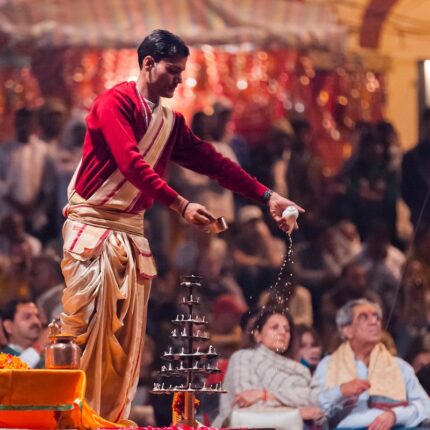
A la tombée de la nuit, on assiste à une puja, cérémonie d’offrandes au cours de laquelle, chaque soir, la statue de bronze de Shiva est menée à la chambre du temple de son épouse Meenakshi. Musique lancinante
Jour 8
Madurai – Aéroport International de Chennai
Flâneries au marché et Musée Ghandi
On this last day, the purpose of strolling is purely for pleasure. Do you enjoy wandering the alleys of working-class neighborhoods? Your steps lead you to the flower markets of Madurai. Every day, thousands of flowers are sold in profusion as offerings to the deities. Then, at the Gandhi Memorial Museum, you delve deeper into the history of the Father of India, who dedicated his life to the people and the country. In the late afternoon, your driver will take you to Madurai Airport, from where you will return to Chennai Airport for your international flight.
Included in the price
- Assistance from your travel expert once on site, 7 days a week.
- Our assistance before and after the trip.
- Transfers and ground transportation in private vehicle (luxury mini bus) with English-speaking driver.
- Accommodation: hotel in standard double room.
- Meals: all breakfasts.
- Domestic flight from Madurai to Chennai.
- All breakfasts and dinners.
- French-speaking guide
Not included in the price
- International flights.
- International airport taxes.
- Visa fees.
- The visits and activities mentioned in the program.
- Cancellation, assistance and repatriation insurance.
- Drinks and personal expenses.
- Tips.
- Anything not listed under “included in the price”.
Reviews
There are no reviews yet.